 Caravel
How to build this business, step by step.
A phased plan for setting up a spice and oud trading company that imports and exports worldwide. Timings are indicative, and each step should be confirmed with your registration authorities and a qualified adviser.
Milestone tracker
Tick each milestone as it is reached. Progress is saved in this browser only, and feeds the launch-readiness KPI on the home page.
Register the company and trade identity
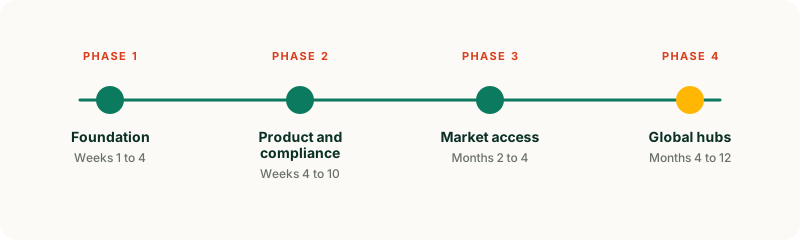
Weeks 1 to 4. Everything here is needed before you can trade, invoice or open a bank account for export.
Choose the legal structure
Private limited company or LLP in India for the origin business, and a holding or trading entity in each hub country (for example a free-zone company in Dubai or a BV in the Netherlands). Get tax and corporate advice before you choose.
Incorporate and open banking
Register the company with the Ministry of Corporate Affairs, obtain PAN and TAN, and open a current account with foreign exchange facilities. Check the company name against trademark and domain availability first.
Apply for the Importer Exporter Code
The IEC from the Directorate General of Foreign Trade (DGFT) is a prerequisite for all imports and exports. Your name and address must match across PAN, GST, bank and FSSAI records.
Register for GST and file the LUT
Register for GST, then file a Letter of Undertaking so exports can be made without paying integrated tax upfront. Keep export invoices and shipping bills for refund claims.
Register with the Spices Board
Obtain the Certificate of Registration as Exporter of Spices (CRES). Choose merchant or manufacturer exporter status based on whether you process spices. Confirm current fees and the process on the Spices Board portal.
Obtain the FSSAI licence
Apply for the FSSAI licence appropriate to your activity: central licence for larger trading or processing, state licence otherwise. Food-safety compliance is checked by buyers and customs at every destination.
Build the quality system and sourcing base
Weeks 4 to 10. Buyers will ask for these documents before they place a first order.
Set up HACCP and an ISO 22000 plan
Write hazard analysis and critical control points for each product line, and plan for ISO 22000 or FSSC 22000 certification. Document cleaning, pest control and traceability from the first lot.
Partner with an accredited lab
Contract an NABL-accredited or ISO 17025 lab to issue a certificate of analysis for every lot, covering moisture, volatile oil, pesticide residues, aflatoxins, heavy metals and microbes.
Contract sourcing, with backup origins
Sign supply agreements with farmers, cooperatives and processors in at least two origins for each key spice. Agree grades, moisture limits and traceability rights in writing.
Secure storage and processing
Lease or build a warehouse with pest control, temperature and humidity control, and fumigation records. If you process or blend, check the facility requirements for manufacturer exporter status.
Confirm oud plantation and CITES steps
Register oud supply only from plantations with forest-department documentation. Confirm the DGFT quota and conditions for chips, powder and oil, then set up the CITES export permit process with the Management Authority before the first contract.
Open buyers and logistics
Months 2 to 4. Start with two or three markets rather than all of them.
Map each destination's import rules
For every target market, list residue limits, labelling, registration and import permit rules. Examples to research first: EU maximum residue limits, US FDA food facility registration, and GCC halal and food-import requirements.
Build the sample and buyer pipeline
Prepare spec sheets, COA samples and a price list per Incoterm. Target importers, roasters, food manufacturers and private-label brands, and track every sample through to a quotation.
Arrange trade finance and insurance
Agree letter of credit lines and documentary collection terms with your bank. Take out cargo insurance and, where useful, export credit insurance for buyers in higher-risk markets.
Appoint freight forwarders and customs brokers
Choose forwarders for FCL and consolidated loads from Kochi, Chennai, Mundra and Nhava Sheva, and a customs broker for each destination. Agree document turnaround times in the contract.
Scale across regions
Months 4 to 12 and beyond. Add hubs once volumes justify the cost of local stock and staff.
Open regional hubs
Set up bonded or free-zone stock in your first hub, such as Dubai, Rotterdam, Singapore or New York. Each hub needs a local entity, tax registration, warehouse licence and a hub manager.
Add global certifications
Work toward FSSC 22000 or BRCGS for retail buyers, and organic certification (NPOP, USDA NOP or EU Organic) if you sell organic lines. Each certification adds markets and raises prices.
Build the team
Hire a trade compliance lead, a quality manager, regional sales managers and a logistics coordinator. Set up monthly reviews of margins, lot rejections, claims and on-time delivery.
Talk to our onboarding team.
Tell us your target spices, markets and volumes, and we will map the first phase for your business.
Request a Quote